
Most advice a gallery gets about visibility is still built for a search engine that’s disappearing. Fix the meta tags. Get more backlinks. Chase the featured snippet. None of it addresses the actual question an AI system asks before it recommends a gallery to someone: has anyone else already vouched for this. That question is really about online reputation management, even if nobody in the gallery world is calling it that yet.
That’s the shift worth understanding. ChatGPT, Gemini, and Google’s AI Overviews aren’t ranking galleries the way a search engine used to. They’re deciding whether to cite one — and that decision leans heavily on whether the gallery’s claims about itself are backed up elsewhere: press coverage, exhibition records, third-party mentions, a body of work that adds up to a consistent, verifiable picture. In practice, that’s online reputation management by another name: not managing what a gallery says about itself, but what the wider internet says about it.
A gallery can have a fast, technically clean website and still be invisible to AI search. A smaller gallery with a modest site can still be the first name an AI reaches for, if enough of what’s written about it — on its own pages and elsewhere — already agrees on who it is and what it does. Traditional SEO could be won largely alone, with enough time and enough budget. This is closer to a reputation problem than a technical one, and reputation isn’t something a website can manufacture on its own — it has to be demonstrated, consistently, in places beyond the gallery’s own site.
That doesn’t mean the technical side doesn’t matter — it’s the foundation the reputation gets read against. But it does mean the ceiling on AI visibility isn’t set by how well-built a site is. It’s set by how much of the gallery’s real activity — its shows, its artists, its critical reception — is actually visible and connected in a way an AI system can read. Treat it as an ongoing discipline, not a one-off fix, and online reputation management becomes the more accurate description of what AI visibility actually requires.
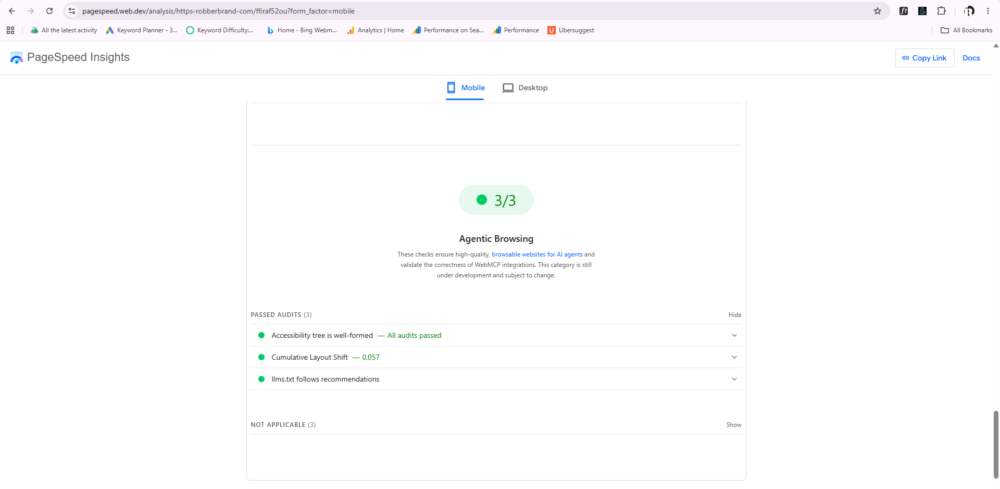
You can check where your own site currently stands in a couple of minutes. Run it through PageSpeed Insights and look at the new Agentic Browsing section — a plain readout of whether AI systems can navigate the site at all. It’s a useful starting point. It isn’t the whole picture.
Related articles: AI Visibility AI Visibility Checker Web IQ WebMCP
Own the answer.