
PageSpeed Insights Now Scores “Agentic Browsing” — Here’s What It Means for Your Gallery Site
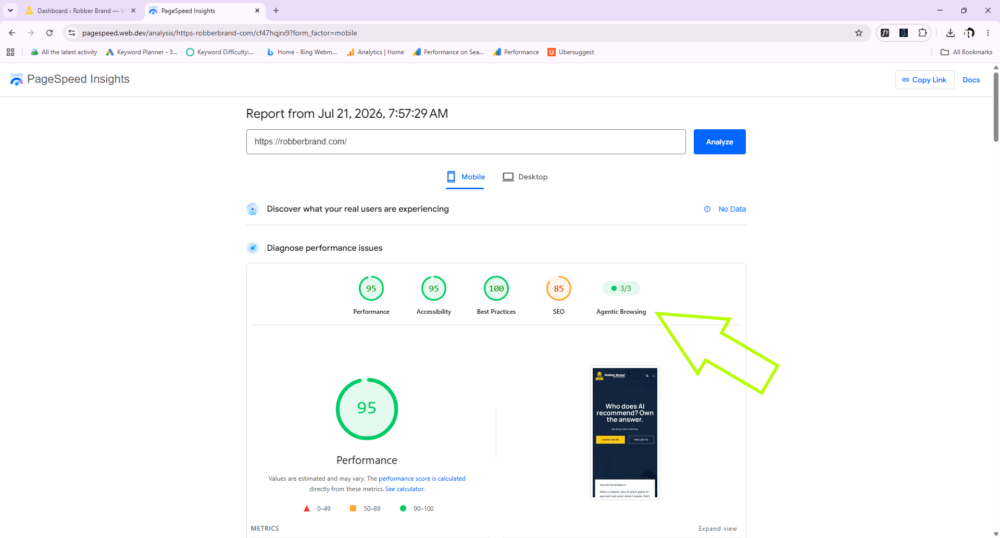
Run your gallery website through PageSpeed Insights and you’ll notice a fifth score sitting next to the familiar Performance, Accessibility, Best Practices, and SEO panels – Agentic Browsing. Google added the category in May 2026 to measure how easily an AI agent can read, navigate, and act on a page — a distinct question from how fast it loads for a person.
What the New Agentic Browsing Score Actually Checks
Instead of a weighted 0–100 score, the category reports a pass ratio — 2/3, 3/3 — because the underlying standards for how AI agents should read the web are still being written.
Three checks make up the default result:
- Accessibility tree quality. AI agents don’t see a page the way a person does. They read the same structural map screen readers use — headings, labelled buttons, properly nested form controls. A page that relies on visual layout alone, with no semantic structure underneath, is largely unreadable to an agent.
- Layout stability. This is your existing Cumulative Layout Shift score, repurposed. A stable layout means an agent interacting with the page won’t misjudge where an element sits while content is still loading.
- llms.txt validity. A plain-text file at your site root, written for a model rather than a person, summarising what the site is and pointing to key pages.
Google has been explicit that this is a diagnostic tool, not a ranking factor — at least for now. It isn’t scoring whether AI search engines cite you. It’s scoring whether your site is structurally legible to the software that increasingly stands between a person and your gallery.
Why It’s Relevant to Artist Authority, But Not the Same Thing
This is where it’s worth being precise, because the two get conflated. A perfect score tells you a crawler can parse your page without tripping over broken markup. It says nothing about whether an AI system considers your gallery the authoritative source on the artists you represent. That’s a separate, harder problem — one of entity recognition, third-party citation, and structured content depth, not page mechanics.
Think of it as the plumbing check. It clears the pipe. It doesn’t put anything worth citing through it. A technically flawless page with thin, promotional artist copy will pass and still be invisible in AI Overviews or a ChatGPT recommendation. The clean technical foundation matters — it removes friction between your content and the systems reading it — but the content itself is what earns the citation.
Building the Content That Fills That Pipe: An Evergreen Artist Page Template
AI systems pull citations from pages that answer a question directly, early, and in a format they can lift cleanly. Most gallery artist pages aren’t built that way — they’re written as exhibition copy, time-stamped and promotional, which AI models tend to treat as disposable rather than reference material. An evergreen structure does the opposite: it reads as a stable, citable entity profile that stays accurate long after the show closes.
A reliable structure for each artist page:
1. A direct opening definition. One sentence stating who the artist is, their nationality, their movement or style, and what they’re known for. This is the sentence a model will lift for a “who is [artist]” query, so it needs to stand alone without context from the rest of the page.
2. Verifiable biographical facts. Birth year and place, training, primary mediums, and key influences, laid out plainly rather than woven into prose. AI systems anchor authority judgements to concrete, checkable details.
3. Style and technique, under proper subheadings. Separate sections for medium/process and for thematic concerns, each answering a narrower question a collector or researcher might actually ask.
4. A structured table of key works. Title, year, medium, and notable collection or exhibition, in an actual HTML table rather than a styled image or a wall of text. Structured data is what makes a page usable in a comparison-style AI response.
5. Exhibition history as a dated list. Solo shows, group shows, and fairs, each with a year and venue. This is the cross-reference evidence that signals the artist — and by extension the gallery — carries real standing.
6. A clear representation statement. One paragraph naming your gallery as the current representative, without turning it into a sales pitch. This is the line that ties the artist entity to your gallery entity in the model’s understanding.
Use real H2/H3 headings throughout rather than bold text standing in for structure — that’s the same accessibility signal the diagnostic is checking for, so the two efforts reinforce each other. Keep the page evergreen: update it as facts change, but write it to still be accurate in three years, not three weeks.
The Order of Operations
Fix the structural layer first if you haven’t — it’s a prerequisite, not a strategy. Then put the effort where it compounds: entity-rich, evergreen artist profiles that give AI systems something specific and verifiable to cite. Passing agentic browsing checks gets an AI agent through the door. Artist Authority is what gets your gallery named once it’s inside.