
Microsoft Just Named the Thing
In June 2026, Microsoft announced Web IQ — a suite of grounding APIs built on the Bing index, but designed for AI agents rather than people. It’s worth reading carefully, because it confirms something Robber Brand has been arguing since May: AI citation and traditional search ranking are no longer the same discipline.
A search engine for AI, not for people
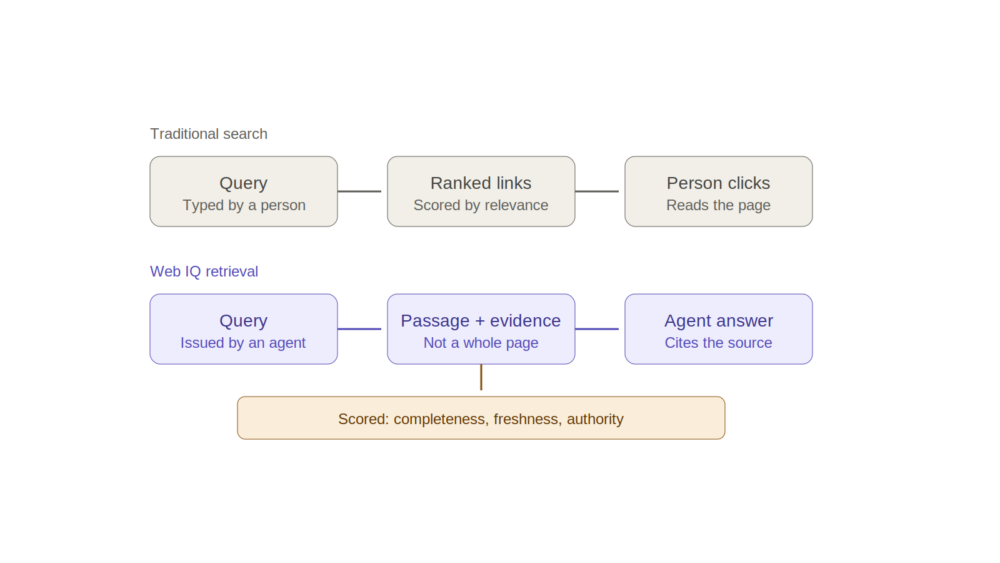
Bing was built to return links a person could click. Web IQ is built to return evidence a model can use. Instead of documents, it returns passages and structured evidence objects — the reasoning being that models don’t need pages, they need information, and a page is often a poor proxy for the information inside it.
That distinction matters more than it sounds. A gallery page can rank well, load fast, and still be useless to an AI system if the facts inside it aren’t structured in a way a model can lift out and cite. Ranking and retrievability have quietly become two different problems.
Worth separating this from WebMCP, a related but different standard Google and Microsoft are developing jointly through the W3C. WebMCP lets a website expose actions an agent can call directly — booking a viewing, submitting an enquiry. Web IQ is about an agent finding and citing information; WebMCP is about an agent doing something once it’s there. Different layer, same direction of travel.
Authority, named explicitly
Microsoft measures Web IQ’s performance with a metric it calls GDSAT — grounding satisfaction. GDSAT scores retrieval across three dimensions: completeness, freshness, and authority.
Authority, as a named, scored component of AI retrieval infrastructure, sitting alongside freshness and completeness. Not backlinks. Not domain rating. Authority — is close to the concept we’ve been calling Artist Authority since Robber Brand launched: whether an AI system recognises a gallery as the authoritative source on the artists it represents.
Microsoft isn’t validating our framing because they’ve heard of it. They arrived at the same vocabulary independently, from the infrastructure side, because it’s what the problem actually looks like once you’re building for agents instead of people.
What this means for galleries
Most gallery websites were built, and are still maintained, for the version of search that’s disappearing. Traditional SEO optimises for rank. Web IQ — and the broader shift it represents — optimises for whether a system trying to answer “who represents this artist” can find a clean, structured, authoritative answer on your site and pull it out.
Those aren’t the same target. A gallery can sit on page one of Google for its own name and still be invisible the moment an AI system is asked a specific question about one of its artists. The infrastructure Microsoft just shipped is a direct, dated illustration of why.
The practical takeaway
This isn’t a call to panic-migrate platforms. It’s a reason to treat structured, citable, artist-level content as infrastructure rather than decoration — because the systems now retrieving that content are explicitly built to reward it.
Related articles: Online Reputation Management AI Visibility AI Visibility Checker WebMCP