
For two years, the easiest way to get your brand into AI answers was to write about yourself. Publish a “best of” list, put your own company at number one, and wait for ChatGPT or Google to quote it.
That’s ending. The evidence from this year shows AI search engines learning to do what good analysts have always done: discount the source with an interest in the answer.
For anyone whose reputation now depends partly on what the machines say about them, that’s the most important shift in AI search so far.
The tactic that worked
The logic was straightforward. When someone asks an AI engine for “the best” anything, it looks for pages that answer that question directly. A ranked list does exactly that. So companies, mostly in software, published hundreds of them, each with their own product at the top.
It worked because early AI search was credulous. It cited what was structured and relevant without asking much about who wrote it or why. A list on a company’s own blog, ranking itself first, could end up as the source behind an answer millions of people read.
The SEO industry has a saying for tactics like this: it works until it doesn’t.
What the data now shows
Lily Ray, one of the most closely followed researchers in search, has tracked this all year. In February she documented well-known software brands losing large parts of their search visibility after publishing self-ranked “best” pages at scale.
By June she had found something stranger. Google’s AI Overviews were still citing these self-promotional lists, but leaving out the brand that wrote them 69% of the time. The page was being used as a source while its author was being ignored.
Her September figures went further. Compared with June, AI Overviews cited 38% fewer self-promotional listicles, left out the brands behind them 83% of the time, and in 70% of cases the list was helping competitors get recommended instead. Ranking yourself first had become, in effect, a vote for your rivals.
ChatGPT is moving the same way. Data from Peec AI, which Ray highlighted, shows the share of ChatGPT citations going to listicles roughly halved after a recent model update, from about 16% to under 8%, with comparison pages also falling. In October she shared examples of ChatGPT openly describing self-promotional lists as biased and unfit for making a buying decision.
Not everyone agrees on the cause. Some agencies argue their own self-ranking lists are performing fine and that bad content, not the format, is the real problem. But that view still accepts the core point: AI engines are getting better at telling evidence from advertising.
Why it’s happening
The machines are learning an old lesson. A source with an interest in the answer deserves less weight than one without. Every analyst, editor and investment committee already works this way. AI search is catching up.
The pages that got hit tended to share the same signals: a company ranking itself first with no independent verification, titles refreshed with a new year but no new substance, AI-written text at scale, no sign of first-hand testing, and structured data used to fake reviews or ratings. Google has said in writing that scaled AI content, fake authors and tactics built to game AI answers are what it plans to target next.
None of that is about format. A well-researched comparison by an independent writer is still valuable. What’s losing value is self-interest presented as evidence.
What it means if you’re being pitched AI visibility
This started in software marketing, but it won’t stay there. Infrastructure funds, pension schemes, property groups and publicly backed companies are now being offered “AI visibility” services, and some of what’s being sold is the same playbook in a nicer suit.
The stakes are higher for these organisations. When an investor, a journalist or a civil servant asks an AI engine who is building Britain’s grid, who owns its offshore wind or whether a fund is a good steward of public infrastructure, the answer shapes reputation and, eventually, access to capital and policy. Content that flatters you won’t hold up there, and if the machines learn to discount you as a source, that’s hard to reverse.
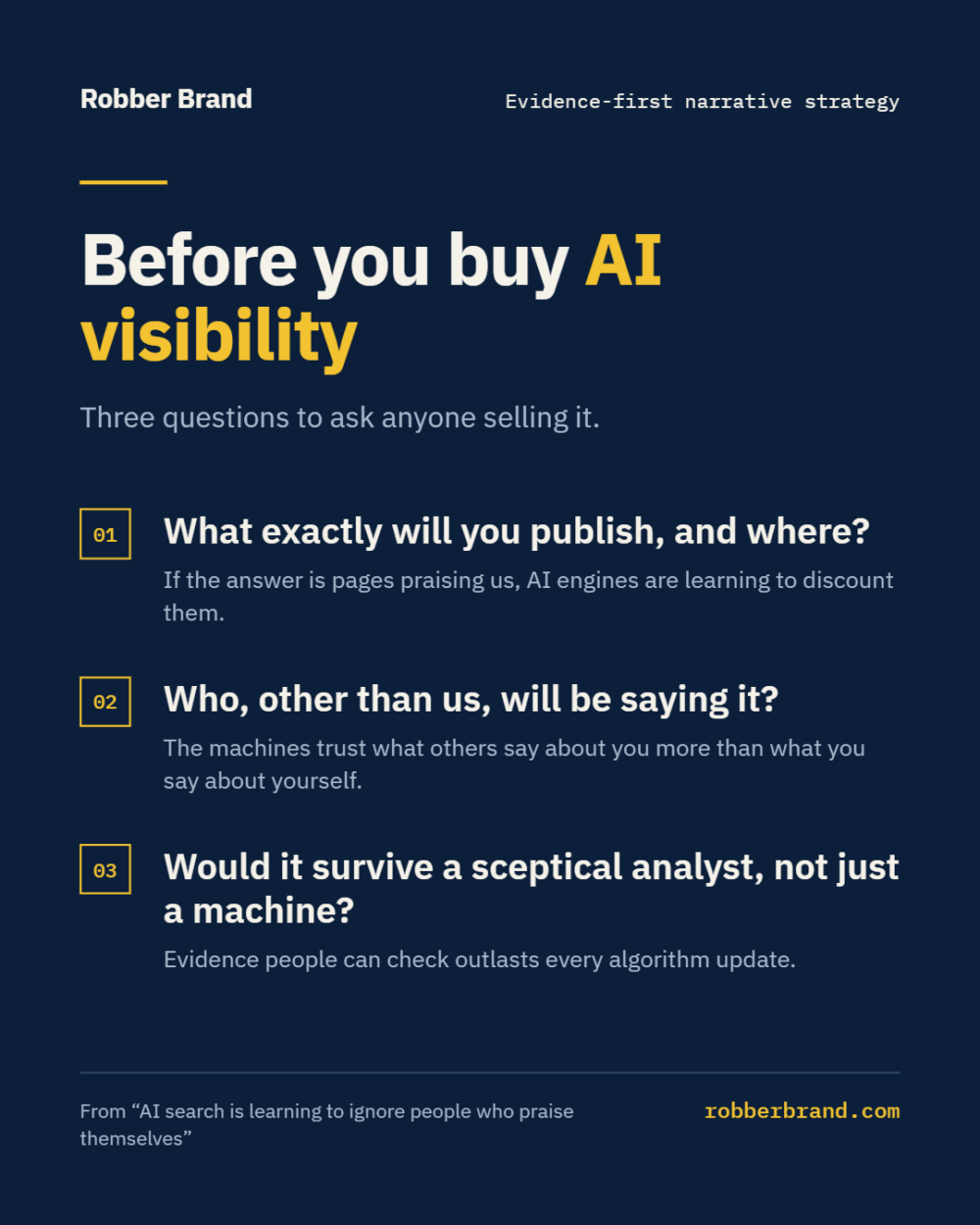
Three questions worth asking anyone selling AI visibility. What exactly will you publish, and where? Who, other than us, will be saying it? And would it survive a sceptical analyst reading it, not just a machine?
What still works
What works now is what always worked: evidence other people can check, and credibility other people confer. Original data. Named experts speaking on the record. Sources cited properly. Mentions earned in other people’s analysis rather than placed in your own.
That’s the principle behind the Artist Authority work still on this site, and it’s the principle behind Robber Brand’s narrative strategy today. Who owns tomorrow will be decided partly by what the machines believe. They’re getting harder to fool, which is good news for anyone with a real argument to make.
More on Narrative Strategy
Sources
- Lily Ray, Is Google Finally Cracking Down on Self-Promotional Listicles?, February 2026
- Search Engine Land, Google AI Overviews cite self-serving listicles, but recommend competitors 69% of the time, June 2026
- Lily Ray on X, updated AI Overviews figures, September 2026
- Lily Ray on X, Peec AI data on ChatGPT citations, August 2026
- Lily Ray, It Works Until It Doesn’t: AI Content Strategies That Backfire, May 2026
- Grow and Convert, Self-Promotional Listicles Aren’t the Problem. Bad Content Is