
Every gallery’s AI visibility strategy stops at the website. That’s the blind spot.
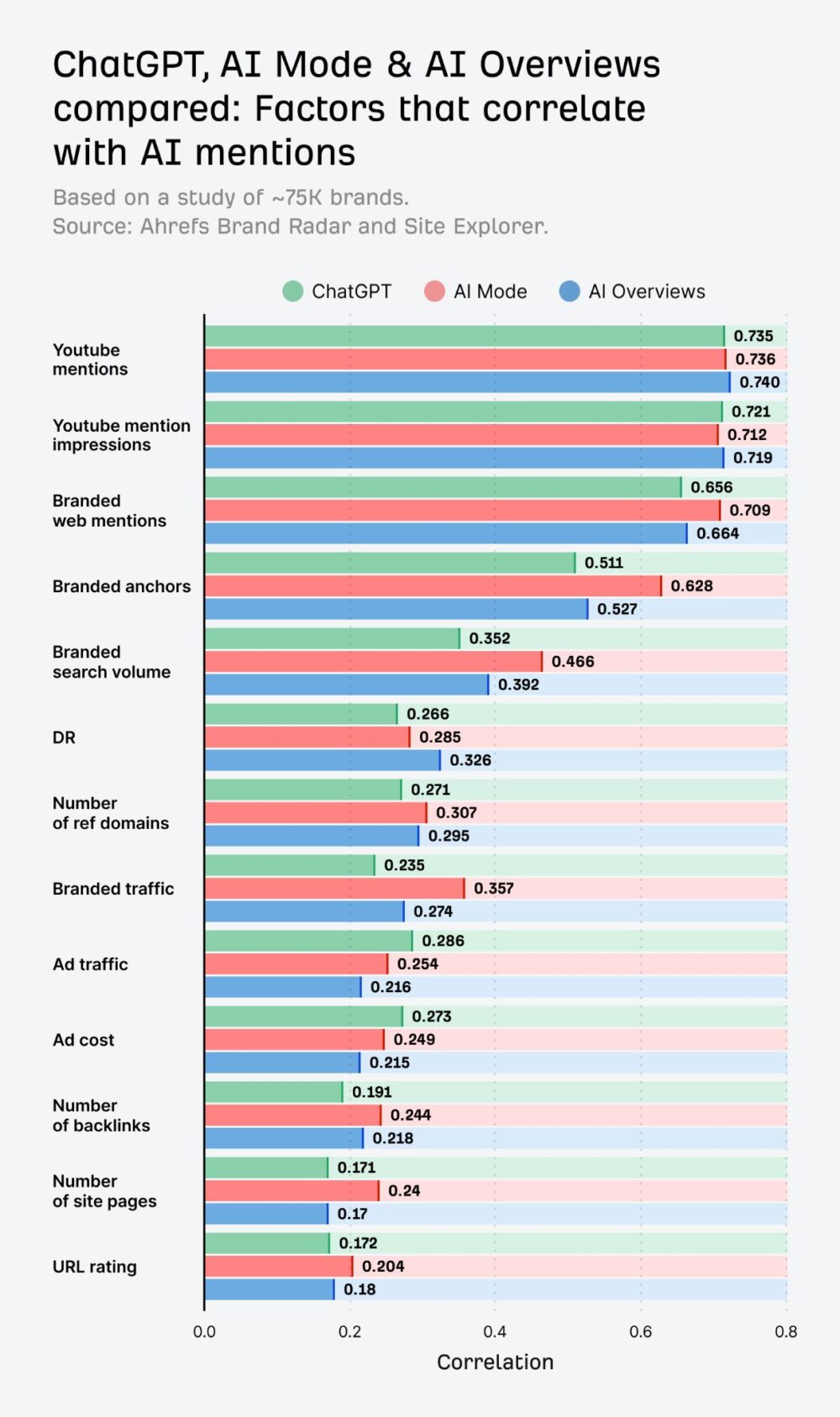
Ahrefs recently studied AI visibility correlations across 75,000 brands in ChatGPT, AI Mode, and AI Overviews. The single strongest factor wasn’t backlinks, domain rating, or page count — those barely moved the needle. It was mentions in YouTube content. Not video views. Not subscriber counts. Mentions — a brand or artist name appearing in a video’s transcript, title, or description.
The mechanism is straightforward once you see it. Both Google’s models and OpenAI’s have ingested enormous volumes of YouTube transcript text during training. A video doesn’t need to be about a gallery to carry Artist Authority signal — it needs the gallery’s name and the artist’s name spoken clearly, together, on the record. The platform functions as one of the largest indexed bodies of spoken-word text on the internet, and almost no fine art gallery is publishing into it with any intent.
This is worth separating from a claim that’s circulating in less careful corners of the internet: that video resolution affects AI visibility. It doesn’t. There is no evidence that 4K production values, upscaling, or cinematic polish influence whether a model recognises a gallery as authoritative. The signal is textual — what gets said and transcribed — not visual. A gallery director speaking plainly into a smartphone about a represented artist carries the same weight, as far as any language model is concerned, as a full crew shoot. Conflating “immersive content” with AI visibility is a category error, and one worth naming before it hardens into received wisdom in this sector.
What actually matters is naming discipline, repeated across content the gallery doesn’t fully control.
Where the opportunity sits
Fine art galleries already produce some of this content. Exhibition walkthroughs. Artist interviews. Studio visit footage shot for Instagram and quietly abandoned. Almost none of it is built with transcript mentions in mind, and almost none of it exists on channels outside the gallery’s own.
That second point matters more than the first. Third-party citation outperforms self-promotion in AI search — a gallery’s own “best of” content gets indexed but is disproportionately excluded from the answers models actually surface. The same dynamic almost certainly extends to YouTube. A studio visit uploaded to the gallery’s own channel is a start. An art critic’s channel, an auction house’s commentary series, or a collector interview naming the gallery and artist together is the stronger signal, because it reads to the model as independent confirmation rather than the subject speaking about itself.
What this looks like in practice
Three moves, in order of effort:
Say the full name, every time. Not “the gallery” or “our represented artist” — the gallery’s proper name and the artist’s proper name, spoken together, early in the video. Transcripts don’t infer context the way a human viewer does.
Title and describe for the entity, not the event. “Studio Visit: [Artist Name] at [Gallery Name]” carries more transcript-adjacent signal than “Behind the Scenes — Summer 2026.” The description field is free real estate most galleries leave blank, and it’s one of the simplest AI visibility gains available to a gallery with no technical resource at all.
Seed third-party mentions deliberately. Offer artists and critics footage, quotes, or interview time specifically because it puts the gallery’s name in someone else’s transcript. This is outreach, not production.
The honest caveat
This is a new and largely untested extension of the Artist Authority framework — the underlying data comes from Ahrefs’ own Brand Radar tool, measuring correlation rather than proving causation, and no one has yet run a controlled test isolating YouTube transcript mentions from the dozen other variables that move together with them. Treat it as a strong AI visibility signal worth acting on, not a guaranteed lever.
What’s not in doubt is the gap. The text web has a visibility problem for galleries that’s now well documented. The video web has the same problem, unexamined, sitting in plain sight on a platform every gallery already uses and none are using correctly.
Related articles: Online Reputation Management AI Visibility Checker WebMCP
Go deeper: Bing Indexing Exhibition Calendar Fresh Copy Websites For Artists Page Template WebMCP Listicles LAPADA GEO Growth Sell Artwork
Read the full Ahrefs report here.