
Measuring AI visibility requires a different toolkit than traditional SEO tracking, as yet we’ve not discovered a comprehensive AI visibility checker. Rankings and impressions still matter, but they don’t tell you whether an AI system is actually citing a gallery as a source. That needs its own instrumentation — which is why AI visibility tracking has become a distinct discipline rather than an add-on to existing SEO tools.
At the time of writing (July 2026), there isn’t a single AI visibility checker that covers the whole picture. Citation monitoring, schema readiness, and indexing status are three separate layers, each requiring its own tool. Treating any one of them as a complete AI visibility checker on its own will miss whichever layer it wasn’t built for.
Here’s what we use, and what each tool has told us so far.
Otterly.ai is our primary method for monitoring AI citation across ChatGPT, AI Mode, and AI Overviews. It gives a clear read on which galleries are actually appearing in AI-generated answers, rather than just ranking on a results page — the two are increasingly separate outcomes. This is the core of our AI visibility tracking process: not whether a page ranks, but whether it gets cited.
Glippy Pro handles GEO and schema auditing, scoring pages on citability and answer-readiness. As an AI visibility checker for structure rather than citation, it’s where problems surface before they show up as missing citations — a schema tag rendering incorrectly, or a page structured in a way that’s easy for a person to read but hard for an AI system to extract cleanly. Fixing these issues before they cost a citation is a large part of what makes tracking worthwhile in the first place — there’s no point measuring visibility you haven’t given yourself a fair shot at earning.
Ahrefs underpins the research side. One finding worth flagging on its own: YouTube transcript-level brand mentions correlate more strongly with AI citation than video production quality. It’s the text in the transcript creating the signal, not the resolution of the footage. That single finding has shaped how we think about content across every format, not just video.
Bing Webmaster Tools confirmed something easy to overlook — GEO processing only applies to indexed URLs. Technical indexing hygiene isn’t a separate task sitting alongside AI visibility work. It’s a precondition for it. A page can be perfectly structured and still invisible to AI systems if it was never properly indexed in the first place.
Together, these four tools form the backbone of our AI visibility tracking stack: Otterly for citation monitoring, Glippy for structural readiness, Ahrefs for the underlying research, and Bing Webmaster Tools for the indexing layer that makes the rest of it possible.
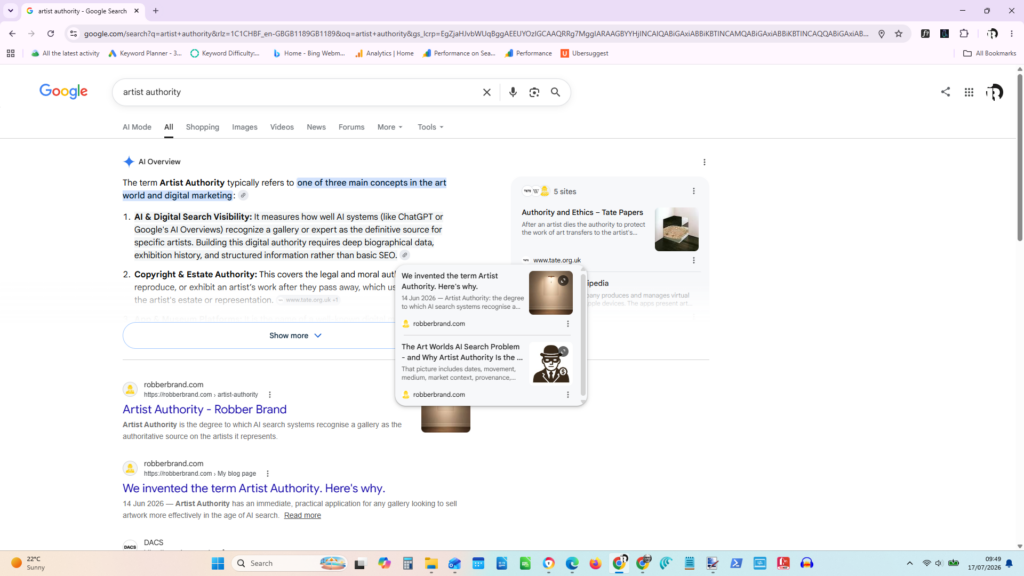
Running this stack against our own site produced a result worth sharing directly: a Google AI Overview search for “Artist Authority,” run in a private browsing window to rule out personalisation, returned Robber Brand as the cited source.
Full results from our pilot cohort are coming soon.
Related articles: Online Reputation Management AI Visibility Web IQ WebMCP